Three Proposals
NZTA: Move into the 21st Century
Distance not Years
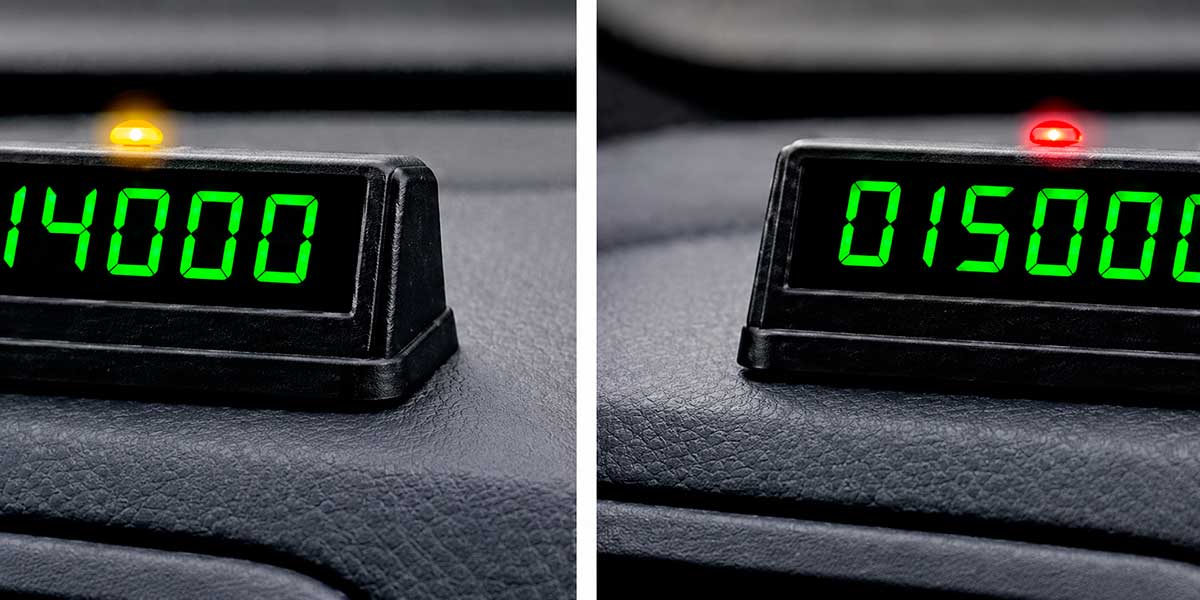
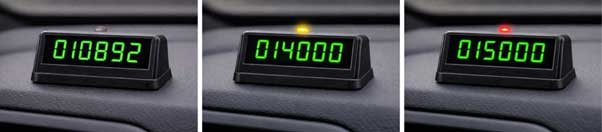
Vehicles require mechanical inspections based on physical distance driven, not elapsed calendar time. For a $15 per-vehicle hardware cost, a tamper-proof GPS counter can signal a mandatory WoF every 15,000 km, instead of an arbitrary annual deadline. The real safety items wear by km—tyres, brakes, suspension, and steering. For low-use collectible fleets, a standard 10-year inspection backstop remains to check for age-deteriorated parts including hardened rubber and body corrosion.
- Universal RUC Model
- Eliminate annual Rego fees and built it into RUC
- Change ACC charges to RUC
- This eliminates the unfair lapsed rego inspection
- No windscreen paper, no WoF paper, all digital
- See https://collectible.nz/wof/ for details
VIRM 3-4 “signs of…” on collectibles
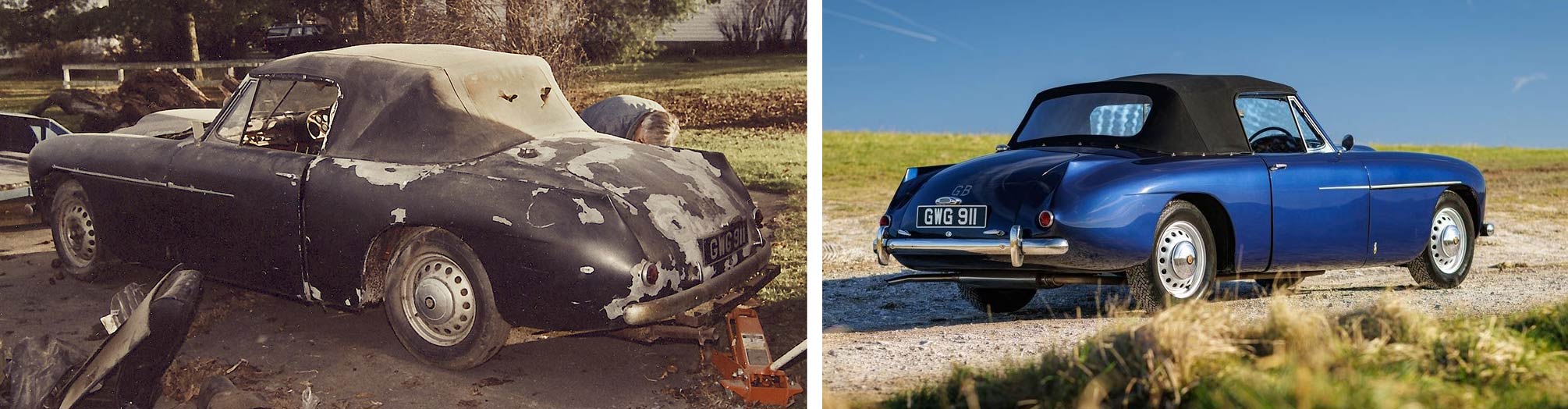
A safe collectible will have signs of repair, etc.
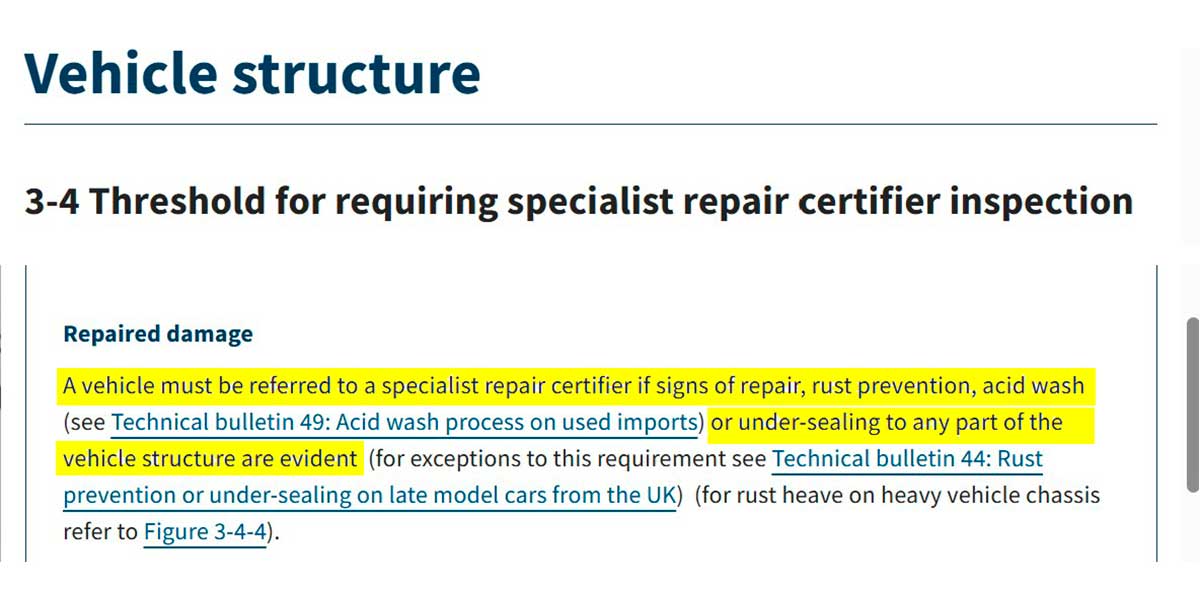
Late-model imports sold to the general public should have a referral to a repair specialist if the vehicle shows signs of repair, rust prevention, acid wash or undersealing because it may be an overseas insurance write-off being presented as a safe vehicle by covering up the damage.
Applying this to a collectible, typically 25+ years old, does not have a safety basis. To the contrary, almost all collectibles will have evidence of repair, prevention and protection. Indeed, almost all fail under the current VIRM, despite having no evidence that the vehicle is unsafe. The other parts of VIRM 3-4 adequately capture the real safety issues. If a vehicle has actual underbody damage, denting, distortion, cracking, water or fire damage, corrosion, or rot, it must be referred. But the presence of “signs of” repair does not make it unsafe and should not apply to collectibles.

Litigate
Apply to the High Court for a Determination
The Land Transport Act 1998 and the Vehicle Standards Compliance Rule 2002 require that motor vehicles used on NZ roads are safe. When NZTA makes rules that are ultra vires (beyond the powers granted by law), if they refuse to change the law, or delay for years, as they did before Hon Chris Bishop exercised his power as Transport Minister to get them to act, the alternative is to ask the High Court for a declaration.
A declaration is solely a question of law. It does not involve a particular vehicle. High Court litigation is expensve and needs a good lawyer. To proceed, the collectible community would need to find a lawyer willing to do it on a fixed fee basis, or pro bono. We would then need to start a give-a-little campaign to pay for the court case.
See https://collectible.nz/claim/ for details.
Understanding the Collectible Economy
- $16.5 billion total economic footprint
- 369,600 collectible vehicles in NZ
- Over 200,000 collectors in NZ
- 26% of NZ would love to own one
- 71% of NZ sees them as part of NZ heritage
- $52,500 average collectible value
- $6,355 average annual spend per vehicle
- 5,200 jobs directly supported
- $1.53 billion total annual sector spending
- 3,700 km average annual driving distance
- No serious crashes involving collectibles
- No deaths/serious injury involving collectibles
- Lower insurance cost due to fewer claims
- Lower claims as collectors drive more safely
- Lifetime CO₂ of a new petrol car ≈50 tonnes
Lifetime CO₂ of a new EV ≈15 tonnes
Remaining CO₂ of a collectible vehicle ≈5 tonnes
The $16.5 billion collectible vehicle economy
It’s about passion, not profit
There are over 200,000 Kiwis who own collectible motor vehicles. In contrast to the approximately 20 major manufacturers represented on NZ roads as daily transport vehicles, more than a thousand motor vehicle manufacturers have existed since 1900.
The vast majority of those thousand marques are represented in NZ by a few vehicles in the hands of collectors, ranging from a 1901 Locomobile (one registered in NZ) to a 1981 DeLorean (eight registered in NZ). Classic, vintage, antique, historic, heritage, veteran and modern-classic vehicles are known by many names, but together they form the broader category of collectible vehicles.
The collectible vehicle economy is worth preserving. To do so, NZTA must ensure its regulations are fit for purpose and not unnecessarily onerous. This website sets out the changes needed.

This is a transportable
Purpose: Daily Transport
NZTA regulates vehicles that are part of the national transport system. These vehicles are relied upon by the public for everyday mobility and commerce. Because most consumers cannot assess the mechanical condition or safety of these vehicles themselves, the state regulates the industries that sell, repair, maintain and inspect them. Consistent regulation is necessary to ensure safety across the transport fleet.

This is a collectible
Purpose: Heritage and Enjoyment
Collectible vehicles are not part of the functional transport fleet. They are historic chattels maintained and preserved within New Zealand’s $16.5-billion collectible-vehicle economy. Owners are typically experienced enthusiasts who restore, maintain and care for these vehicles as cultural artefacts. They are rarely used for daily transport and represent a specialised sector with different patterns of ownership, use and risk.

Memo to Hon Chris BISHOP
Minister for Transport
NZ’s collectible vehicle economy
involves over 200,000 enthusiasts, restorers and small businesses,
yet it has no large national lobby.
Collectors look to the Minister to ensure regulation affecting collectibles is fit for purpose.
The recent decision to extend the WoF interval for 40-year-old vehicles from six months to one year recognised the distinct nature of this sector. The next issue deserving review is VIRM 3-4.
The WoF meter – from years to k’s
A $15 digital distance recorder in every on-road vehicle would shift WoF and road user charges from time to distance.
New Zealand’s current WoF system is a legacy of the analogue era. Windscreen stickers could record an expiry date, but not how far a vehicle had travelled.
That constraint is gone. The 20th century has ended. The system has not.
Vehicles wear out by kilometres, not years. Tyres and brakes do not age on the driveway. They wear on the road. It’s time to move WoF into the digital age.
To the Minister for Transport:
The wording of VIRM-3-4 Repaired damage is damaging the collectible economy
The issue
25 years ago, Kiwis would search the planet for barn finds – vehicles with collectible value in need of a complete restoration, or perhaps just some loving care. They would ship them home, do the necessary body and mechanical work, take it for the First Entry Inspection which would usually pass unless they missed something.
Typically they would have to change the seat belts or get a waiver, RHD lights, a high stop light, and ensure tyres, brakes and steering were safe. Almost all would show signs of having been repaired – either over a long lifetime or or during the fresh restoration carried out either by the owner or by a specialist restoration shop.
But then, it all changed. What were called cowboy importers were buying insurance write-off cars, mostly from Japan, and selling them in NZ as clean-history, late-model imports. Flood or crash damage would be concealed, but soon show up on the front pages of the news. NZTA rewrote the first-entry inspection rules, including one called VIRM 3-4. The VIRM says:
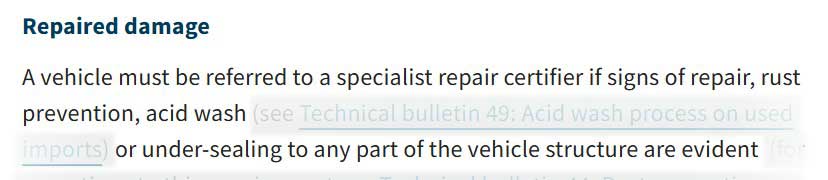
These 29 words in VIRM 3-4 decimated NZ’s collectible import industry
Why? Liability, not Safety
In practice, entry inspectors tend to refer vehicles whenever visible indicators listed in VIRM section 3-4 are present. This is not necessarily because structural damage is suspected, but because of how responsibility is structured within the certification system. If an entry inspector fails to identify structural damage and the vehicle is later found to be unsafe, the inspector’s authority can be suspended or revoked. By referring the vehicle to a specialist repair certifier, the responsibility for assessing structural integrity is transferred to the certifier. As a result, the safest professional decision for an inspector is often to refer any vehicle showing visible indicators such as repairs, rust prevention, or under-sealing, even when those indicators may simply reflect normal restoration work on an older vehicle.
An economy not an industry
Unlike the mainstream used-car-import industry, almost all collectible vehicles are imported by keen amateurs—individuals who search the world for their marque, put it on a ship, and begin the joy and pain of restoring it not merely to roadworthy condition, but to as close to as-new condition as they can afford.
Very few do it for profit, and most operate on tight budgets. They need every dollar and every hour of their time to go into making the vehicle better, not into triggering a specialist repair certification process that can cost $15,000 even when there is no evidence of structural damage requiring such intervention.
In most cases, the owners who get caught out have already completed a major restoration, only to be told the structural restoration must be undone.
The First Entry inspection costs $700. If the car fails, it must be repaired within 28 days (far too short for specialist repair certification) or the certification lapses. That doubles the paperchase cost to $1,400. But that is only the entry fee.
The specialist repair certifier is held liable for their certificate, so to protect themselves they often require all underseal and some topcoat paint to be blasted off and holes to be cut in structural members for inspection, with a typical cost to restore the vehicle to finished condition of around $15,000.
That cost adds nothing to the value of the car, but for the typical collector it is a drop-dead cost. As a result, the restoration industry contracted and due to the drop in business, some of the best restoration shops closed or were tipped into liquidation. The VIRM created collateral damage to the collectible economy.
Other Problems with VIRM – deregistration
At one time, insurance claims that resulted in the write-off of a vehicle were a good indicator that the vehicle was unsafe for road use. More recently, however, with the cost of body repair becoming much higher, both due to health, safety and emissions regulations affecting panel beaters and the rising cost of repairs, insurance companies are writing off vehicles that are structurally safe, but whose market value is lower than the cost of repair. These vehicles, as well as vehicles where the owner has allowed the registration to lapse, become caught in the $15,000 specialist repair certification trap.
The problem here relates to an apparent unofficial policy to get old cars off the road in NZ. Anecdotally, industry insiders are saying that NZTA has added an environmental mandate based on the belief that old cars are bad because they pollute more and offer less protection in the case of a serious crash.
This is a legitimate safety concern when focused on “old bangers,” which tend to be purchased by inexperienced or high-risk drivers, but the collateral damage to the collectible car economy is neither justified nor appropriate.
A further problem: A lack of qualified inspectors
Repair Specialist Certifiers are generally trained on the approximately 20 manufacturers of late-model vehicles, all of which have similar engineering design. Very few will have experience of the 1,000 makes of vehicles imported or reregistered as collectibles. The answer is not train certifiers in obscure cars, but to ask why third-party certification is necessary when statistics show it is not a problem.
The problem comes with a collectible, where signs of fresh repair, rust prevention, acid wash or under-sealing are all perfectly safe, and in most cases are signs of a restoration rather than an unsafe condition. Adding the adjective “fresh” does not address this, and it is likely a case can be made the whole rule is ultra vires.
Solution
The immediate, interim solution is to revise VIRM 3-4 repaired damage to revise the words to exclude collectible vehicles. This could be based on year of manufacture, or an exclusion list maintained by a respected organisation such as the NZ Vintage Car Club which is already recognised by NZTA. See below:
Amending VIRM 3-4 Repaired Damage
Question to NZTA Regarding VIRM Section 3-4 – Repaired Damage
The empowering legislation governing entry certification establishes that the purpose of the inspection process is to ensure vehicle safety. In the case of collectible vehicles, visible evidence of prior repair and rust prevention is common given the age and history of such vehicles. Indeed, a freshly restored collectible vehicle, even when restored to a high standard, will almost inevitably display visible evidence of repair to parts of the vehicle structure while remaining structurally sound and safe for road use.
VIRM section 3-4 Repaired Damage states:
“A vehicle must be referred to a specialist repair certifier if signs of repair, rust prevention, acid wash, or under-sealing to any part of the vehicle structure are evident.”
Please explain how the presence of “signs of repair, rust prevention, acid wash, or under-sealing” indicates a safety risk, specifically where there is no evidence that the repair has affected the vehicle’s structural integrity or safe operation. In particular, please explain the safety rationale for requiring mandatory referral to a specialist repair certifier—an invasive and often very costly process that can run into five figures—based solely on the presence of these visible indicators, and how such a consequence is proportionate to the safety risk identified, if any, given that the statutory purpose of entry certification is to assess vehicle safety.
The Hierarchy of Law, Rules and Requirements
Vehicle certification in New Zealand operates under a clear legal hierarchy. At the top sits the Land Transport Act 1998, which sets the overall purpose of the transport regulatory system. The Act requires that the land transport system operate in a way that is safe, effective, and efficient.
Under the Act, the Government issues binding secondary legislation known as Land Transport Rules. The rule relevant to vehicle certification is the Land Transport Rule: Vehicle Standards Compliance 2002. This Rule establishes the legal framework governing how vehicles enter or re-enter the New Zealand vehicle fleet, including both entry certification and repair certification. Unlike manuals or guidance documents, the Rule has the force of law.
The Vehicle Inspection Requirements Manual (VIRM) sits one level below the Rules. The Vehicle Inspection Requirements Manual – Entry Certification is an operational manual used by vehicle inspectors when applying the Rules. It explains how inspections should be carried out and what inspectors should look for. However, the VIRM is not legislation. It is an administrative document and must remain consistent with the Act and the governing Rules.
Because the VIRM is administrative guidance rather than law, it can be challenged if it goes beyond what the statute or the Rule allows. In legal terms, this is known as acting ultra vires, meaning beyond the authority granted by legislation. A challenge may also arise if the manual misinterprets the Rule, substitutes a different test from the one established in law, or applies a policy that defeats the statutory purpose.
Administrative Route
Before taking a dispute to court, it is normal in New Zealand to first approach the regulator directly. The usual first step is to write to NZTA, asking the agency to explain the legal authority for the provision in question and how it aligns with the governing legislation and Rule. At the same time, a request can be made under the Official Information Act 1982 seeking internal documents that explain how the policy was developed, what safety evidence was relied upon, and when particular wording was introduced.
If the agency cannot demonstrate that the manual is supported by the legislation or the Rule, it may choose to revise the manual without the need for litigation. Agencies sometimes correct manuals when a credible legal concern is raised.
Judicial Route
If the issue cannot be resolved through dialogue, the final step is an application for judicial review in the High Court of New Zealand. In such a case the Court does not rewrite the Rule itself, but it can declare that an administrative interpretation is unlawful and require the agency to reconsider its policy.
This process ensures that administrative manuals remain aligned with the law passed by Parliament and that the vehicle certification system continues to operate in a way that is safe, effective, and efficient, as required by the Land Transport Act.
Ministerial Route
While most rules are agency-initiated, there is a second pathway, Minister-Initiated Rule Change.
The Minister can direct officials to begin work on a rule change where a policy issue has been identified.
This type of initiative may arise from:
• public concern
• submissions from industry or community groups
• recommendations from advisory bodies
• government policy priorities.
When the Minister asks officials to review a rule, the regulatory agency then undertakes the same formal process of analysis and consultation before an amendment is issued.
The recent change to the Warrant of Fitness regime for older vehicles illustrates this pathway. After concerns were raised by historic-vehicle groups, the Minister directed officials to review the inspection regime. That process ultimately resulted in vehicles 40 years and older requiring annual WoF inspections rather than six-monthly inspections.
Transportable Motor Vehicle

Transportable motor vehicle (transportables) means any motor vehicle used for transport and utility purposes, including transport of people or goods, but excludes collectible motor vehicles.
Collectible Motor Vehicle

A vehicle qualifies as a collectible vehicle if two or more of the following criteria apply:
-
- It is 25 years or older.
- It is recognised as collectible by the Vintage Car Club of New Zealand.
- It qualifies as a Special Interest Vehicle or Left-Hand-Drive collectible import under NZTA rules.
- NZTA has determined it to be of collectible or historic significance.
- It is maintained primarily for preservation, restoration, display, or enthusiast ownership rather than routine daily transport.
2026 – Public Domain